
NEUROCUB >>
Safety & Clinical Supervision Framework
Clinical Control & Safety Architecture
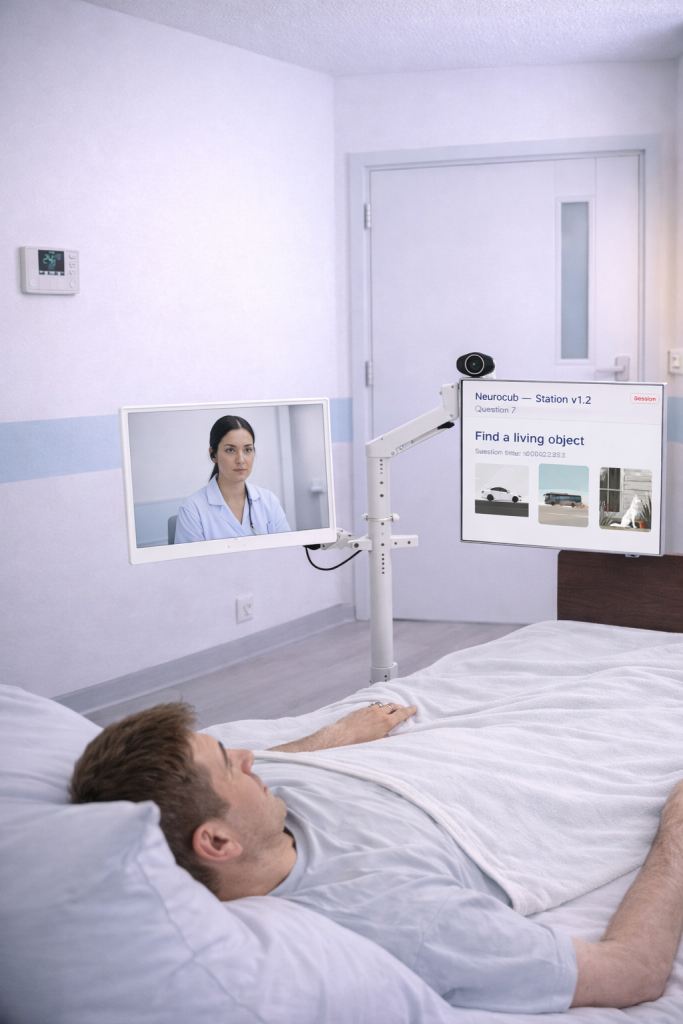
Within Neurocub Software, therapeutic progression is governed by structured clinical control layers rather than open-ended automation:
The system operates through five supervised control domains:
• Session boundary controls — predefined duration limits, structured start/stop logic
• Adaptive load ceilings — controlled difficulty escalation within safe neuroadaptive ranges
• Fatigue & engagement monitoring — automatic detection of performance instability
• Regression protection logic — automatic downshift when instability thresholds are reached
• Operator override capability — real-time human intervention at any point during therapy
Neurocub does not autonomously “push” the patient.
It operates within defined therapeutic envelopes, ensuring progression remains measurable, supervised, and clinically appropriate.
Neurocub operates within clearly defined clinical use parameters. The system is intended for supervised rehabilitation environments and is not designed for unsupervised autonomous cognitive training. Session duration, load ranges, and progression pathways are structured to remain within safe neuroadaptive limits.
Human oversight remains essential. Operators monitor engagement, emotional response, fatigue signals, and behavioral stability throughout each session. Neurocub supports clinical judgment but does not replace professional supervision.
The system includes structured difficulty ceilings and adaptive boundaries. Cognitive load cannot escalate beyond predefined therapeutic ranges. Progression is controlled, measurable, and clinically moderated.
Neurocub continuously evaluates reaction time shifts, accuracy variance, hesitation patterns, and stability indicators. When overload or regression markers appear, the system automatically stabilizes task complexity and pacing.
The platform prevents uncontrolled cognitive escalation. If performance destabilizes, difficulty levels are adjusted downward within safe parameters. Therapy progression is structured — not reactive or random.
Clinicians maintain real-time intervention capability. Operators can pause, redirect, or recalibrate sessions at any moment. Neurocub is designed as a supervised adaptive system — never an autonomous therapy driver.
How safety operates during Neurocub sessions
Safety in Neurocub is not a separate layer — it is embedded in every stage of interaction.
1. Controlled session initialization
Each session begins within predefined therapeutic boundaries based on patient history, baseline tolerance, and clinician-defined parameters. The system establishes a safe cognitive load corridor before interaction begins.
2. Continuous monitoring
During therapy, Neurocub tracks engagement stability, reaction time fluctuation, error structure, pacing consistency, and fatigue signals in real time — without interrupting the patient experience.
3. Adaptive stabilization
If overload markers emerge, the system reduces complexity, adjusts pacing, or introduces stabilization intervals. Cognitive exposure remains regulated within safe neuroadaptive limits.
4. Structured progression control
Difficulty increases are intentional and measured. Progression occurs only when stability thresholds are met. The objective is controlled therapeutic growth — not uncontrolled escalation.
5. Human oversight integration
The operator provides motivational support, behavioral observation, and clinical interpretation. Human cognition naturally conserves energy; guided supervision ensures that therapeutic effort remains constructive and safe.
6. Longitudinal safety tracking
All sessions contribute to a structured longitudinal clinical record. Clinicians monitor fatigue tolerance trends, stability coefficients, and regression risk indicators across time — ensuring that therapy remains appropriate as the patient evolves.
Neurocub therefore functions within a supervised clinical envelope — combining adaptive intelligence with defined safety architecture and human control.

Clinically Supervised Session Management
Every Neurocub session is conducted under the guidance of a trained operator.
The operator does not merely observe — they actively manage the therapeutic process.
During each session, the operator:
• Initiates and configures the session within defined clinical parameters
• Maintains structured dialogue with the patient
• Monitors behavioral response, emotional tone, and engagement stability
• Detects early fatigue or resistance signals
• Intervenes when necessary to stabilize interaction
The session is therefore not autonomous.
It is a supervised clinical interaction supported by adaptive technology.
Neurocub provides the structured cognitive framework —
the operator ensures therapeutic safety, motivation, and human alignment throughout the process.
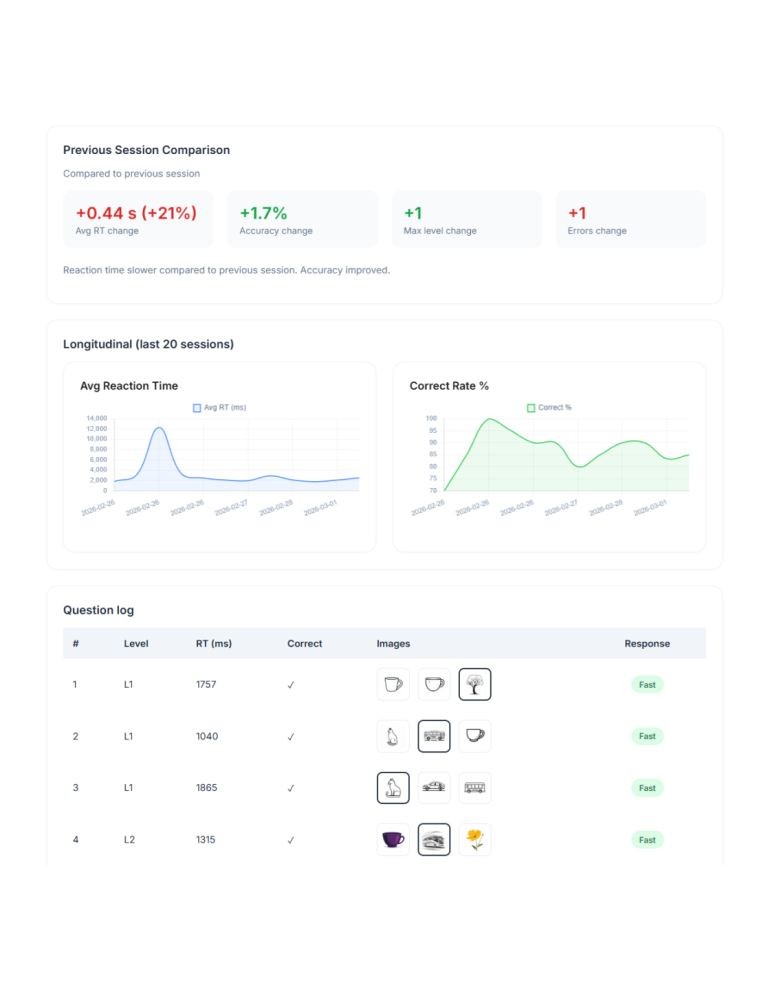
Safety-Embedded Adaptive Architecture
Neurocub Software is built as a supervised adaptive clinical system.
Its architecture integrates safety controls at every level of interaction.
Unlike open digital training tools, Neurocub operates within predefined therapeutic boundaries:
• Controlled difficulty ceilings
• Regulated progression logic
• Real-time overload detection
• Structured pacing control
• Operator override capability
Adaptive adjustments are never random.
Load escalation occurs only when stability thresholds are met.
The system continuously evaluates reaction latency, accuracy shifts, behavioral consistency, and fatigue indicators — ensuring that cognitive stimulation remains within safe neuroadaptive limits.
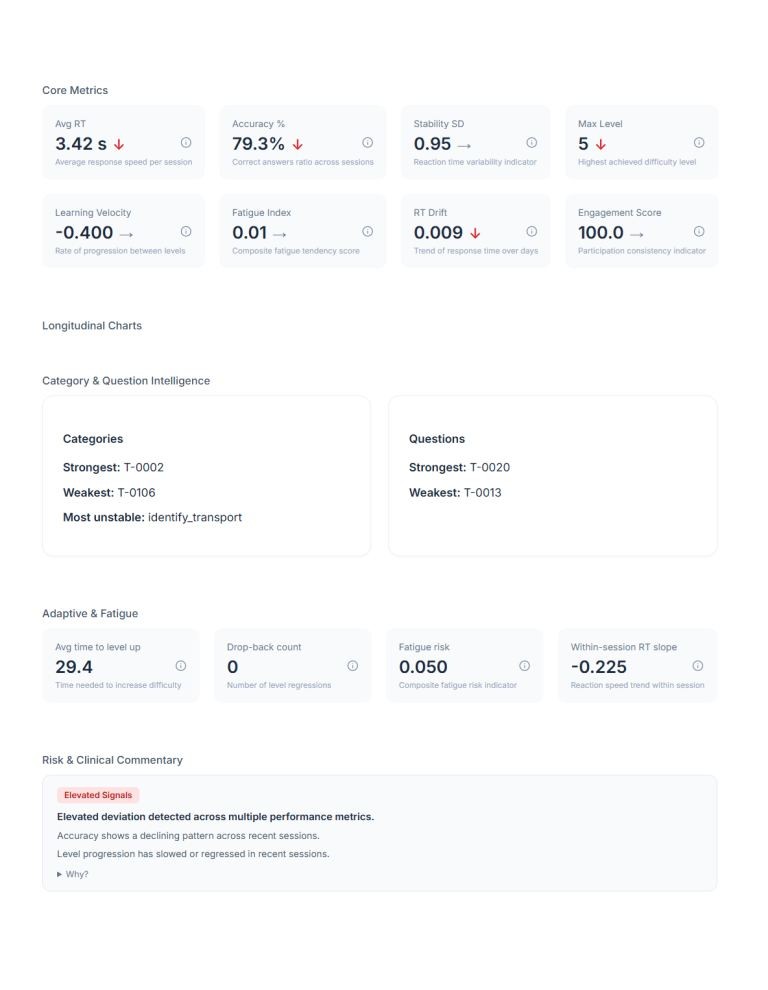
Continuous Clinical Oversight & Longitudinal Safety Monitoring
After each session, Neurocub consolidates interaction data into a structured longitudinal safety profile.
The system tracks:
• Stability trends
• Fatigue tolerance evolution
• Reaction time variability
• Regression risk indicators
• Engagement continuity metrics
Clinicians do not evaluate isolated exercises.
They monitor measurable cognitive dynamics across time.
This longitudinal oversight enables early detection of instability, controlled progression planning, and clinically responsible therapy scaling.
Neurocub transforms bedside interaction into a continuously supervised clinical environment — combining adaptive intelligence with defined safety architecture and human control.
Neurocub Clinical Session Intelligence Framework
Clinical context of the session: duration, completed tasks, therapy mode, and active cognitive domains.
Attention stability, engagement continuity, and fatigue emergence throughout the session.
Changes in processing speed, error structure, decision confidence, and learning patterns.
Updated multidimensional cognitive profile generated by Neurocub Software.
AI-generated clinical interpretation and structured recommendations for the next session.
Cross-session trends showing how key metrics evolve over time — enabling objective progression tracking and early regression detection.
