NEUROCUB >>
SOFTWARE
How Neurocub Builds an Individual Clinical Pathway

Within Neurocub Software, the system is built around five core pillars:
• Bedside software infrastructure — patient interface, clinician dashboard, and supervised interaction environment
• Structured cognitive therapy engine — progressive exercise frameworks, recovery domains, and session architecture
• Adaptive engagement system — real‑time adjustment of difficulty, pacing, and task selection per patient
• Clinical performance metrics — attention, reaction, recognition, memory, task stability, and engagement dynamics
• Workflow integration layer — alignment with existing rehabilitation workflows, documentation, and staff routines
Neurocub Software is designed to deliver continuous, supervised bedside cognitive therapy while maintaining clinical control, consistency, and objective session data.
The software and hardware interaction environment. It includes Neurocub Software interfaces, visual modules, touch input, audio, voice control, and future extensions such as gaze tracking and emotional response analysis. This layer is responsible for delivering digital stimuli and capturing every form of user response.
A structured content and logic system of Neurocub Software. It consists of interactive cards, visual objects, scenarios, recognition tasks, memory blocks, and attention modules. The content is not random — each element is classified by load type, processing logic, and difficulty level.
The analytical core of Neurocub Software. The system processes user responses in real time: speed, accuracy, pauses, repetitions, behavioral patterns, and response stability. Each action is converted into a structured digital metric.
A dynamic adaptive engine. It adjusts system parameters in real time: complexity, pacing, repetition, sensory load, logic depth, and task type. Instead of static scenarios, the user receives a continuously evolving interaction model.
An engagement and attention retention system. Responsible for positive reinforcement, progress visualization, micro-achievements, pacing control, and overload prevention. The goal is to maintain active interaction without loss of stability or interest.
The analytics and control interface. Here, specialists and administrators access structured data: activity dynamics, response stability, progress curves, behavioral patterns, and alerts. Neurocub Software transforms user sessions into a measurable and controllable data system.
How sessions work in Neurocub Software
A session is not a random set of tasks. Each session is a structured clinical micro‑model designed to measure, stimulate, and recalibrate the patient’s neurocognitive state in real time — under supervision.
1. Session initialization
Before the first tasks are shown, the system applies an individualized starting configuration based on baseline status, session history, and clinician‑defined parameters. This establishes a safe starting point and a clinically controlled load range.
2. Task presentation
The system presents structured stimuli (visual recognition, attention, memory, sequencing, and association tasks). Each task is a measurement instrument — not entertainment.
3. Response capture
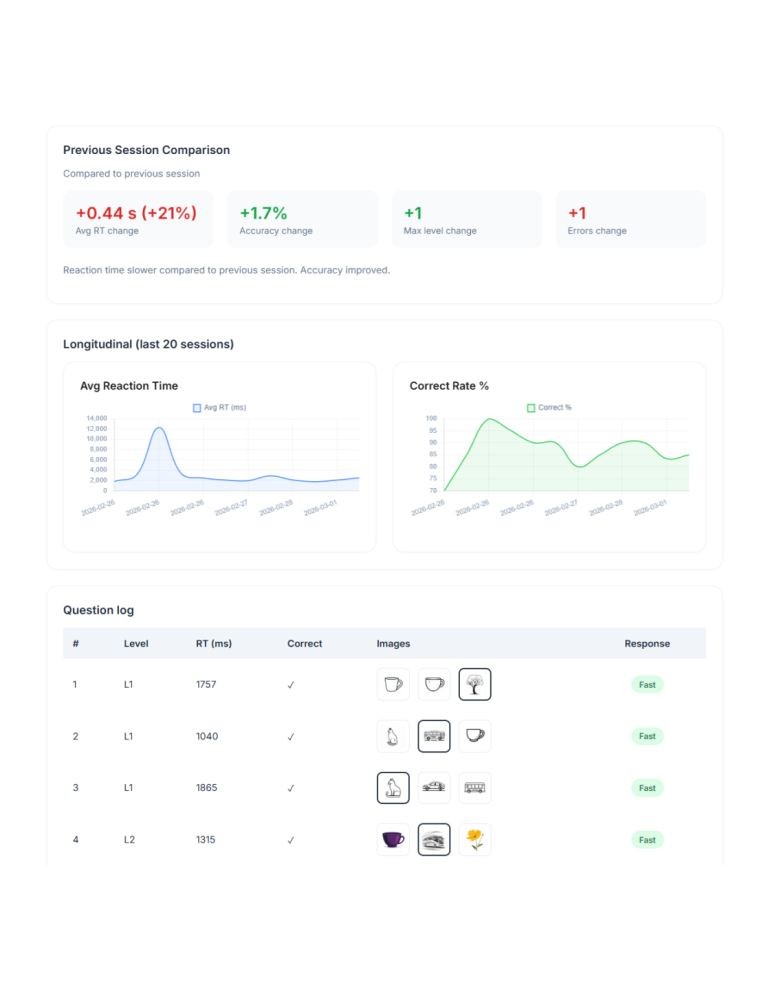
Neurocub captures not only correctness, but the response process: reaction time, hesitation, retries, micro‑corrections, and behavioral stability markers.
4. Real‑time analysis
During the session the system continuously evaluates: attention stability, reaction latency, error structure, engagement continuity, and fatigue signals — without interrupting the interaction.
5. Adaptive next-step generation
The system does not operate as a guessing game.
Tasks are not selected randomly.
Neurocub plans cognitive load progression intentionally.
Difficulty is increased across sessions in a structured manner, ensuring that:
• Cognitive resistance gradually rises
• Processing complexity expands
• Task abstraction deepens
• Decision latency shortens
• Stability improves
The objective is controlled growth — not entertainment.
6. Progressive difficulty architecture
Neurocub is not a “guess the picture” game. Tasks are selected by clinical optimality, and difficulty is planned to grow across sessions — so the patient’s problem‑solving capacity increases longitudinally.
7. Operator support (supervised engagement)
Human supervision remains essential. The operator helps in moments when the patient loses focus, becomes disengaged, or shows resistance. Human cognition naturally conserves energy — neuroplastic adaptation requires guided effort. Neurocub functions not as a “brain gym,” but as cognitive scaffolding that gently supports the patient toward increasingly independent steps.
8. Session consolidation & clinical picture update
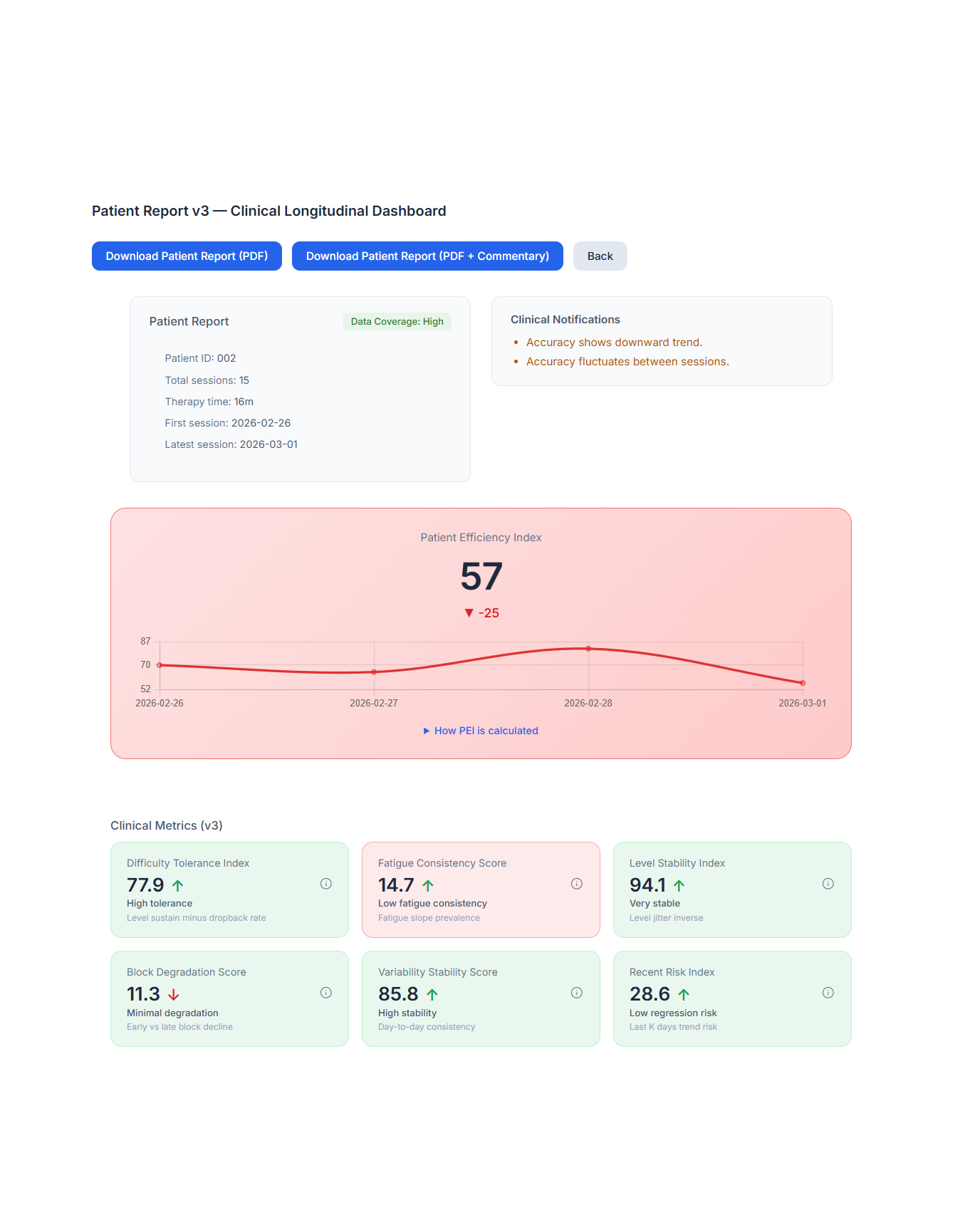
After each session, the system consolidates results into a structured clinical record and updates the patient’s longitudinal cognitive profile. Clinicians see not isolated tasks, but measurable dynamics: stability, engagement, fatigue tolerance, reaction time trends, and progression across cognitive domains.
9. Neurocub continuously evaluates engagement and fatigue signals.
When cognitive overload is detected, the system reduces sensory intensity, simplifies logic depth, or introduces stabilization intervals.
When stability improves, the system increases task complexity within a safe adaptation zone.
Over time, the platform detects the patient’s cognitive comfort corridor — domains where engagement is naturally higher — and uses them strategically to support more demanding domains.
Each patient therefore experiences a unique adaptive trajectory.

The Role of the Operator
Neurocub is designed to function within a supervised clinical environment.
The operator ensures that each session remains therapeutically appropriate, emotionally regulated, and aligned with the patient’s real-time state.
Specifically, the operator:
• Provides clarifications or prompts when comprehension declines
• Maintains task engagement through verbal guidance and pacing
• Observes behavioral and fatigue signals beyond measurable metrics
• Determines when to pause, adjust, or terminate a session per protocol
• Escalates to licensed clinical staff when required
While the adaptive system manages structured task progression within predefined safety parameters, the operator remains responsible for contextual judgment and human interaction.
Neurocub provides structured cognitive stimulation.
The operator provides clinical presence, situational awareness, and motivational stabilization.
This division preserves both scalability and safety.
Why Neurocub Software Architecture Matters Clinically
Neurocub Software is designed as a closed-loop clinical cognitive system.
Unlike traditional rehabilitation tools, its architecture enables:
• Continuous daily cognitive therapy instead of episodic sessions
• Objective performance dynamics instead of subjective impressions
• Adaptive therapy pathways instead of fixed cognitive programs
• Structured cognitive datasets instead of fragmented observations
Within Neurocub Software, each session simultaneously fulfills three clinical functions:
• Cognitive therapy delivery
• Objective performance measurement
• Adaptive model refinement
This structure transforms bedside interaction into a continuously operating clinical environment rather than a supplemental digital tool.
From Session Data to Longitudinal Clinical Intelligence
After each session, Neurocub consolidates all interaction data into a structured clinical record.
The system updates:
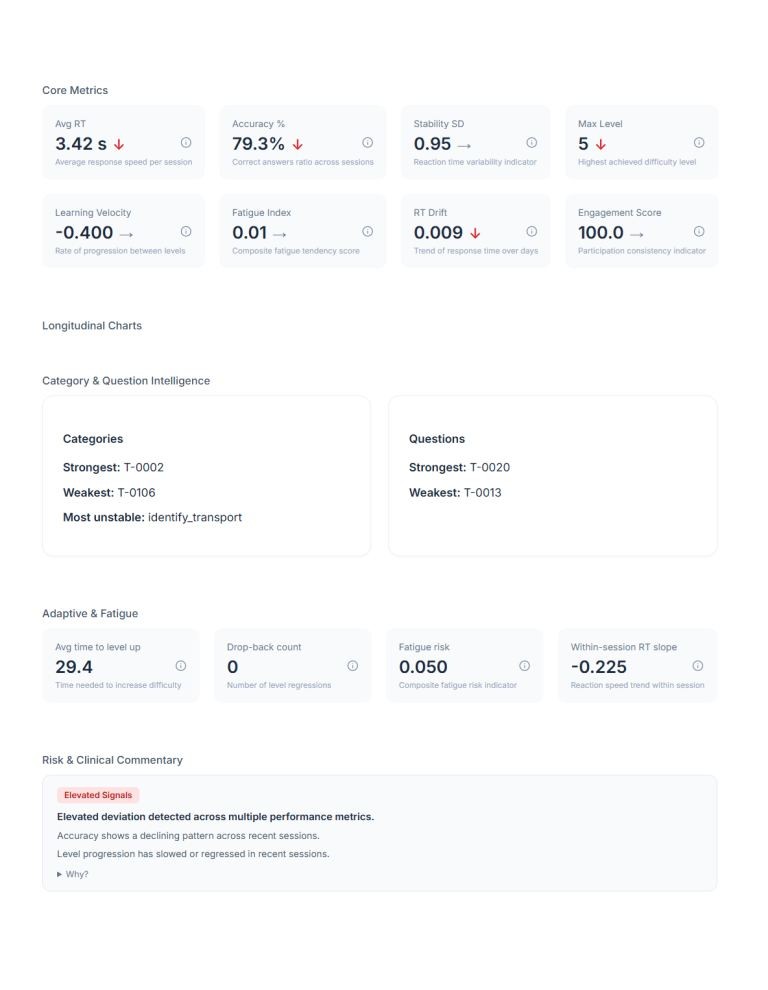
• Multidimensional patient cognitive profile
• Learning velocity indicators
• Stability coefficients
• Fatigue tolerance markers
• Domain-specific progress metrics
The clinical picture evolves session by session.
Clinicians do not see isolated tasks — they see longitudinal cognitive dynamics, measurable progression patterns, and early indicators of stabilization or regression.
Neurocub Clinical Session Intelligence Framework
Clinical context of the session: duration, completed tasks, therapy mode, and active cognitive domains.
Attention stability, engagement continuity, and fatigue emergence throughout the session.
Changes in processing speed, error structure, decision confidence, and learning patterns.
Updated multidimensional cognitive profile generated by Neurocub Software.
AI-generated clinical interpretation and structured recommendations for the next session.
Cross-session trends showing how key metrics evolve over time — enabling objective progression tracking and early regression detection.
