NEUROCUB >> DASHBOARDS & REPORTS

Neurocub Dashboards & Reports transform bedside cognitive sessions into structured, real-time clinical intelligence.

Who this system is for

Neurocub Dashboards & Reports are designed for clinical teams that require structured, objective visibility into patient cognitive recovery:

• Rehabilitation centers
• Hospitals and post-acute departments
• Post-coma recovery units
• Stroke rehabilitation programs
• Traumatic brain injury (TBI) recovery
• Neurodegenerative condition support programs
• Supervised home-care rehabilitation

These are environments where understanding daily cognitive dynamics, fatigue trends, engagement levels, and recovery trajectories is essential for informed clinical decision-making.

Within Dashboards & Reports, Neurocub is structured around five core layers:

Session overview dashboard — duration, activity volume, therapy mode, and cognitive domains engaged
Engagement & fatigue analytics — attention stability, drop-off points, and load tolerance patterns
Cognitive performance metrics — reaction time, accuracy trends, learning gradients, and processing stability
Emotional & behavioral indicators — frustration markers, motivation signals, and interaction consistency
Clinical decision support layer — structured summaries and next-session guidance for therapists

Neurocub Dashboards & Reports convert continuous interaction data into structured, clinically meaningful insights.


What clinical teams receive
Clinics using Neurocub Dashboards & Reports receive a real-time analytics environment — not just visual charts, but structured recovery intelligence.
This includes:

• Live session monitoring dashboards
• Longitudinal cognitive trend analysis
• Fatigue and engagement pattern tracking
• Structured patient profile updates
• Automated session summaries and clinical flags
• Decision-support insights for next-session planning

Dashboards & Reports allow medical teams to observe daily progress, detect subtle changes, and maintain objective documentation of recovery dynamics.

Core purpose of Dashboards & Reports
Neurocub Dashboards & Reports exist to make cognitive recovery measurable, visible, and actionable:
• Transforming interaction data into structured clinical insight

• Highlighting trends instead of isolated task results
• Detecting fatigue and regression early
• Supporting therapists with objective analytics
• Creating a continuous recovery record instead of fragmented notes

This reporting framework ensures that every Neurocub session becomes a documented, analyzable clinical event rather than a standalone activity.
.

Neurocub It is a multi-layered therapeutic system designed to continuously interact with the patient, analyze neurological responses in real time, and dynamically build an adaptive cognitive recovery pathway.

Neurocub Therapy Architecture & Patient Interaction Model.

1. Data capture layer

The structured data environment where session information is collected and organized. This includes interaction logs, response timing, accuracy markers, behavioral signals, and system events. This layer is responsible for transforming raw patient interaction into structured, reportable data streams.

2. Metrics & indicator system

A structured analytics engine consisting of cognitive metrics, performance indicators, engagement scores, fatigue markers, stability indexes, and longitudinal tracking parameters. Each metric belongs to a defined analytical category and contributes to a measurable recovery profile.

3. Real-time analytics engine

The analytical core of Dashboards & Reports. Here, the system processes live session data: timing trends, accuracy dynamics, hesitation patterns, engagement drops, recovery signals, and response stability. Every interaction is converted into structured analytical insight.

4. Trend & trajectory modeling

This layer builds longitudinal recovery trajectories in real time: performance trends, fatigue accumulation curves, attention stability patterns, and improvement vectors. Instead of isolated session results, clinicians see evolving cognitive dynamics.

5. Alert & insight system

Responsible for identifying clinically relevant changes. This includes regression alerts, fatigue thresholds, engagement decline markers, and significant improvement signals. The goal is early detection and informed intervention based on objective data.

6. Clinical dashboard interface

The visualization layer for therapists and clinical teams. Here users access structured dashboards, comparative session views, cognitive trend graphs, performance summaries, and exportable reports. This transforms raw therapy data into clear, decision-support intelligence.
Neurobot V.2.0


How clinical teams work with Dashboards & Reports The reporting and analytics cycle

Every Neurocub reporting cycle follows a consistent analytical logic. This structure allows standardization for clinical environments while enabling deep visibility into each individual patient.


1. Session data aggregation

After each therapy session, the system aggregates structured data.

This can be:
• Automatically synchronized from bedside sessions
• Updated in real time during interaction
• Combined with historical patient data
At this stage, the system organizes cognitive metrics, engagement markers, and performance indicators into a unified dataset.

2. Metric classification

The system categorizes session data into analytical domains:

• Attention stability indicators
• Reaction time metrics
• Accuracy and error structure
• Memory and sequence performance
• Engagement and fatigue markers
Each element functions not only as information — but as a measurable clinical signal.

3. Pattern recognition

Dashboards & Reports analyze multi-layered patterns, including:

• Performance trends over time
• Response variability
• Engagement continuity
• Load tolerance shifts
• Emerging regression signals

The system does not only display numbers — it detects meaningful dynamics.

4. Real-time visualization

As data is processed, dashboards update dynamically.

The system visualizes:
• Cognitive performance curves
• Fatigue accumulation graphs
• Stability and fluctuation patterns
• Comparative session views
• Highlighted clinical alerts
This visualization supports fast and informed decision-making.

5. Insight generation

Based on analytical outputs, Neurocub generates structured insights:
• Identification of improvement vectors
• Detection of overload or fatigue risk
• Recognition of engagement decline
• Confirmation of stabilization trends
• Recommendations for next-session focus
This ensures that data becomes actionable intelligence.

6. Longitudinal profile update

Throughout ongoing use, the system continuously updates the patient’s analytical profile:
• Cognitive domain trajectories
• Performance consistency
• Recovery velocity
• Risk markers
• Engagement sustainability
These updates provide a living, evolving recovery record.

7. Structured reporting

At defined intervals, Neurocub generates structured reports.
These reports reflect:
• Session summaries
• Trend analysis
• Clinically relevant events
• Comparative progress indicators
• Data ready for documentation or export
Dashboards & Reports ensure that every therapy cycle becomes a measurable, trackable clinical record.

Why this structure is clinically important


Neurocub functions as a closed-loop therapeutic system, enabling capabilities that traditional rehabilitation tools typically cannot provide:

• Ongoing daily stimulation instead of isolated sessions
• Quantifiable performance trends instead of subjective impressions
• Dynamic therapeutic adjustment instead of static programs
• Integrated cognitive datasets instead of fragmented notes

Each session simultaneously fulfills three core functions:

• Therapeutic intervention
• Objective measurement
• Continuous model refinement

This integrated structure allows Neurocub to operate not as an add-on tool, but as a structured, intelligent rehabilitation environment.


Example: Bedside Cognitive Session on Neurobot Station 1.3

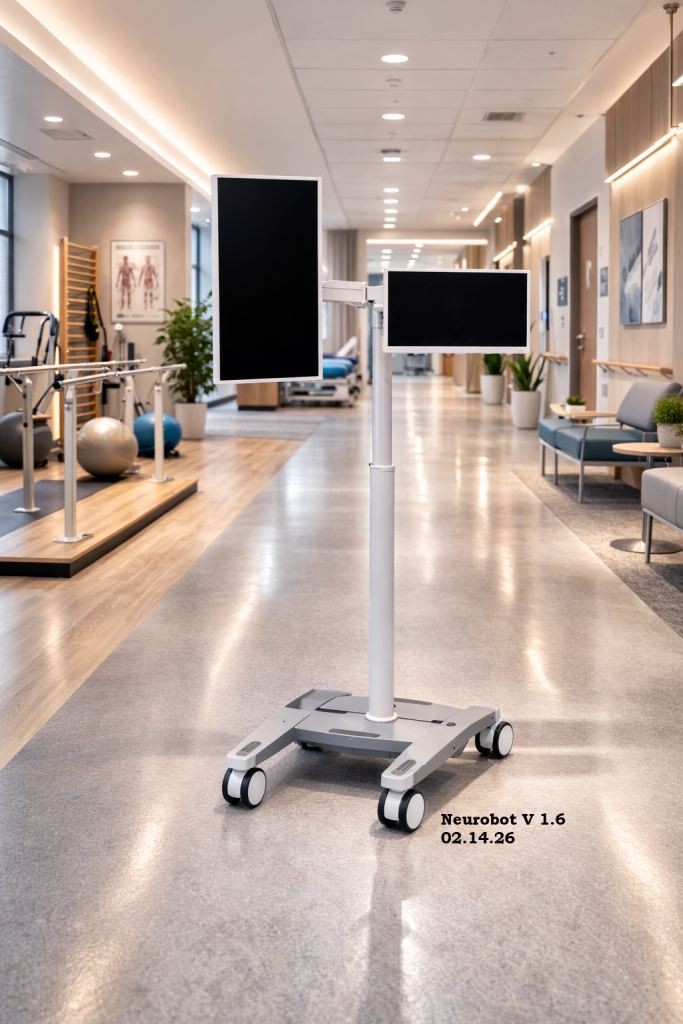
This example demonstrates a bedside cognitive session conducted on the Neurocub Neurobot Station 1.3. The workstation is positioned directly beside the patient’s bed, ensuring stability and accessibility without requiring mobility or physical strain. During the session, the patient interacts with adaptive cognitive exercises while the system continuously evaluates responses and updates the evolving cognitive profile in real time. These sessions are designed for simple initiation, ergonomic comfort, and safe daily repetition in post-acute, post-coma, and limited-mobility conditions. The purpose of deployment is to transform passive bedside time into structured therapeutic engagement while reducing routine cognitive workload for clinical teams.

Neurocub Mini-Session >>
Core Interaction Logic.


I. Session Initialization

Before the first task appears, Neurocub establishes the therapeutic context.

The system uses:

• Previous session history (if available)
• Current cognitive profile
• Clinician-defined parameters (if set)
• Built-in safety baselines

Based on this, Neurocub determines:

• Initial difficulty level
• Acceptable cognitive load range
• Priority cognitive domains
• Emotionally neutral themes
• Session mode (activation, stabilization, development, support)

If the patient is new, the system starts in a protected baseline mode.

II. First Task Selection

The first task is deliberately selected for calibration purposes.

• From the lowest complexity range
• With high probability of successful interaction
• Using neutral content
• With simple interaction mechanics

The objective is system calibration, not intensity.

III. Patient Interaction Event

Neurocub captures the complete behavioral structure:

• Reaction latency
• Response duration
• Correction attempts
• Retry frequency
• Pauses and returns
• Voice activity
• Emotional signals
• Withdrawal patterns

Each interaction becomes a structured cognitive event.

IV. Real-Time AI Analysis

After each interaction, the system evaluates:

• Behavioral signals
• Interaction metrics
• Cognitive indicators
• Emotional markers
• Fatigue signals
• Overload patterns
• Learning dynamics

This produces a live cognitive state snapshot.

V. Dynamic Profile Update

The multidimensional patient model updates continuously:

• Attention stability
• Processing speed
• Error structure
• Decision confidence
• Learning progression
• Fatigue accumulation
• Emotional responsiveness
• Engagement continuity

The model evolves rather than remaining static.

VI. Therapy Decision Layer

The system determines therapeutic direction:

• Maintain domain
• Shift domain
• Simplify
• Increase complexity
• Stabilize
• Insert pause
• Modify mechanics
• Return to baseline
• Gradually extend load

This represents clinical reasoning logic.

VII. Next Task Generation

The next task is selected based on:

• Updated profile
• Previous interaction
• Session trajectory
• Active mode
• Emotional response
• Pacing strategy

Selection is based on therapeutic relevance at that moment.

VIII. Continuous Closed Loop

Interaction → analysis → profile update → decision → next task

Until:

• Load threshold reached
• Fatigue detected
• Objective achieved
• Stability declines

IX. Session Consolidation

At completion Neurocub:

• Consolidates global changes
• Updates long-term model
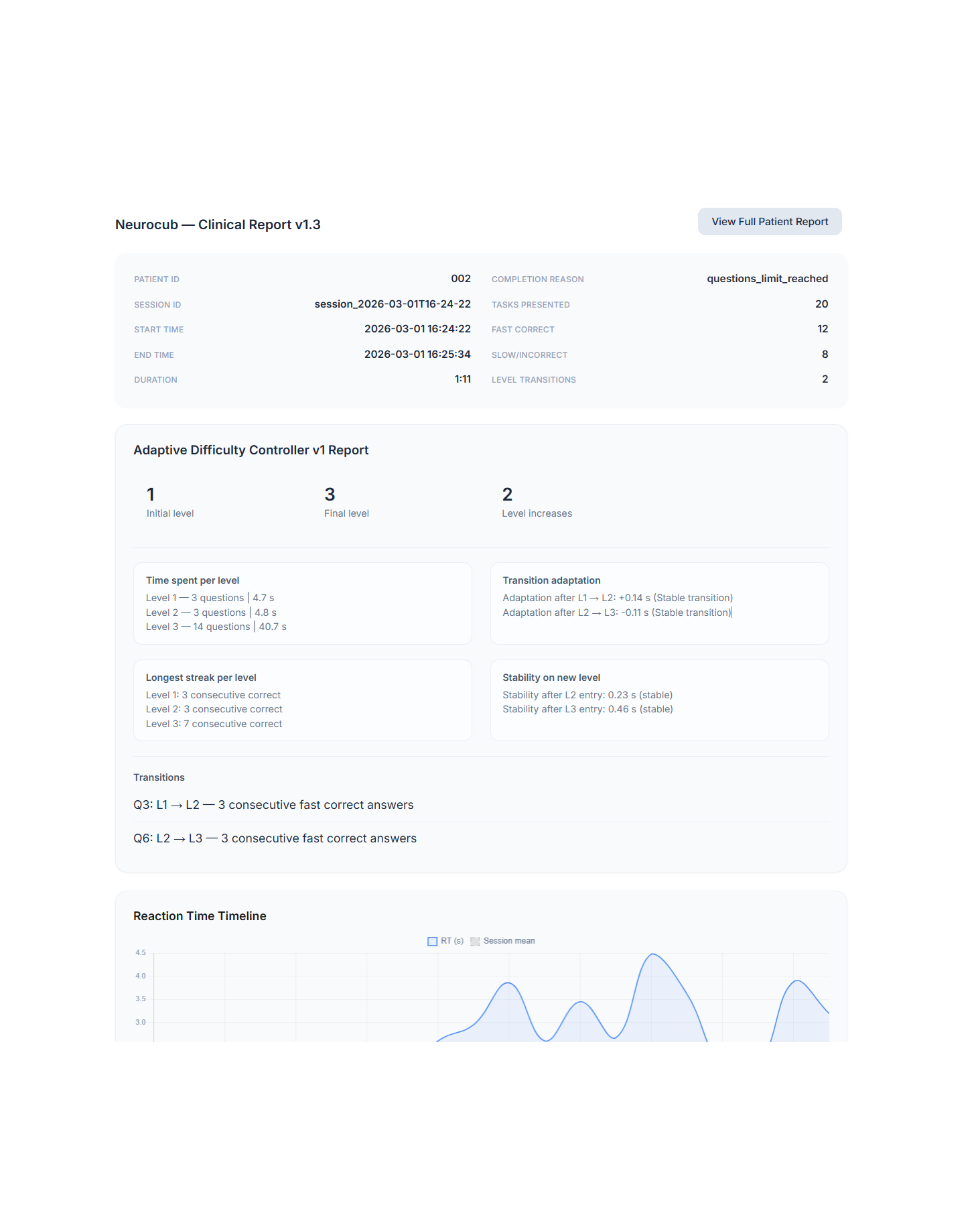
• Generates session snapshot
• Flags relevant events
• Prepares structured dashboard data

System differentiation

• A task is a measurement tool
• A response is a neurocognitive process
• A profile is a dynamic model
• Selection is a therapeutic decision

Neurocub Dashboards & Reports — Core Blocks

System Overview

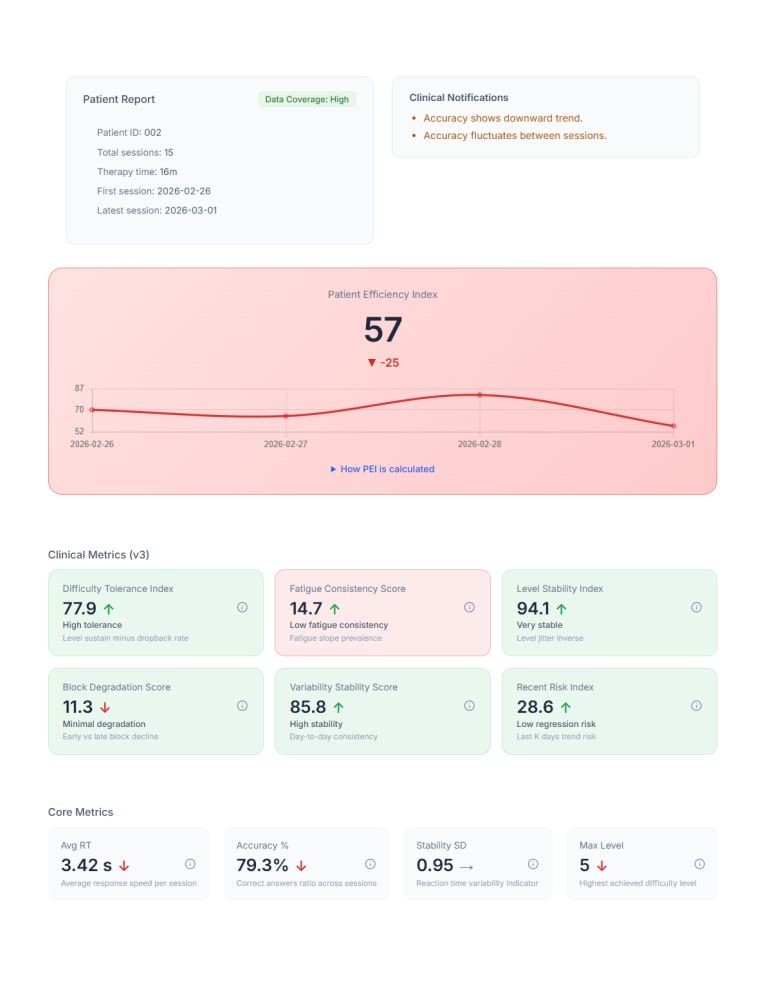
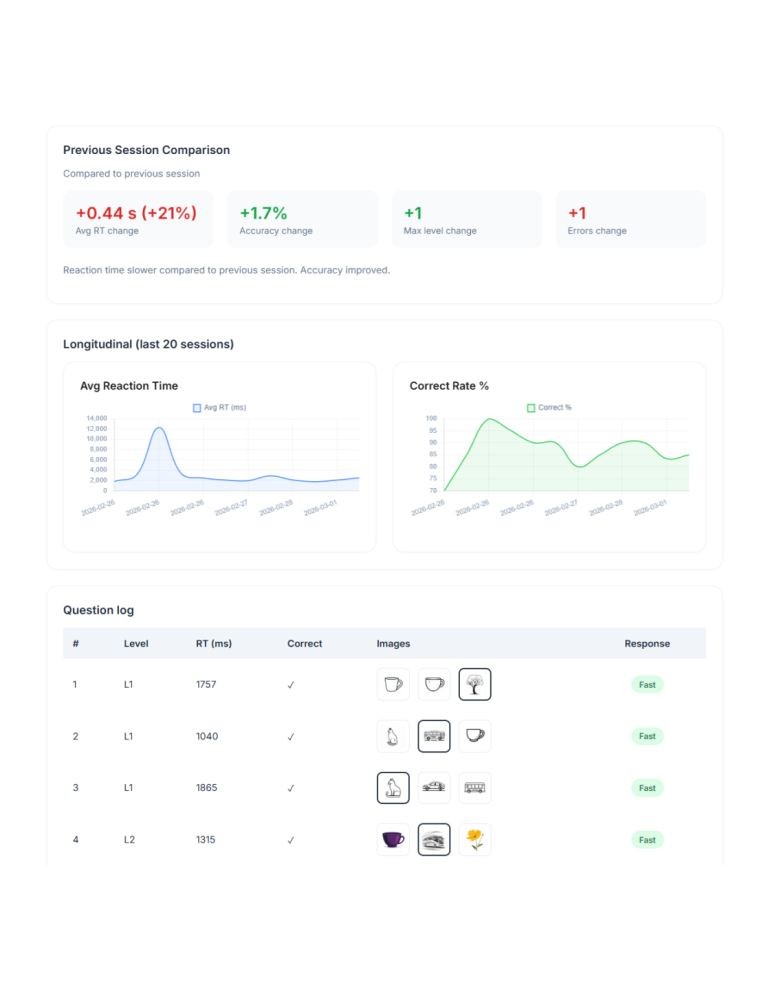
This block provides a structured overview of reporting activity: total sessions analyzed, active patients, reporting timelines, and key cognitive indicators. It defines the analytical context and serves as the reference frame for deeper data interpretation.

Engagement & Fatigue Trends

This section reflects how consistently and how stably patients interact with the system over time. It highlights engagement continuity, attention sustainability, fatigue onset patterns, and interaction intensity curves.

Cognitive Performance Analytics

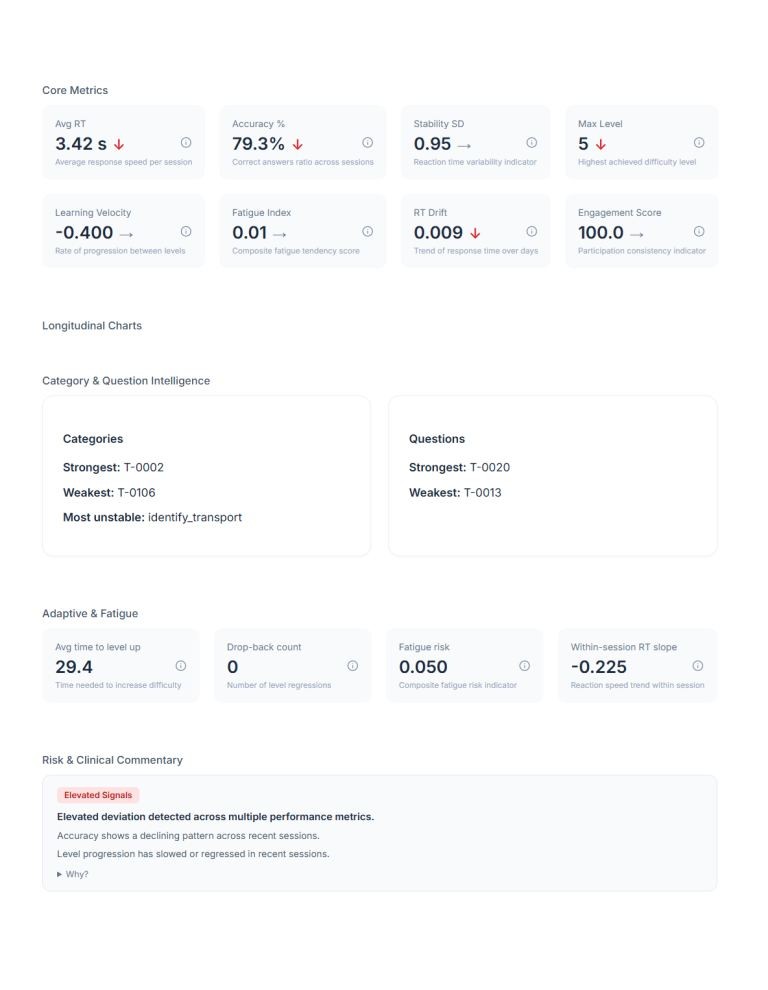
This block analyzes how cognitive indicators evolve across sessions. It visualizes processing speed trends, decision confidence patterns, error structures, and learning gradients instead of isolated task outcomes.

Behavioral & Emotional Indicators

This section captures behavioral and emotional signals derived from interaction data. It highlights motivation dynamics, frustration markers, engagement stability, and emotional response patterns across time.

Updated Cognitive Profile

This block presents the continuously evolving multidimensional cognitive model generated by Neurocub analytics. It reflects attention stability, learning velocity, fatigue sensitivity, processing consistency, and engagement sustainability trends.

Insights & Strategic Guidance

This section summarizes key analytical findings detected by the system and provides structured interpretation. It highlights improvement vectors, potential risk signals, and generates data-driven guidance for clinical review and next-step planning.


Neurocub Analytics Report

Clinical Value & Analytical Deployment


Dashboards & Reports. Building measurable cognitive intelligence.

Neurocub Dashboards & Reports are introduced into clinical environments to transform structured session data into real-time analytical intelligence. The focus is on visibility, interpretation, and longitudinal tracking — enabling teams to monitor cognitive trajectories, engagement stability, and recovery dynamics through clear dashboards and automated reports.

By collaborating with hospitals, rehabilitation centers, and clinical teams, Neurocub analytics validate usability, clarity, and clinical relevance of structured reporting. The objective is to enhance documentation accuracy, support data-driven decisions, and convert daily interaction metrics into actionable clinical insight. This creates a foundation where cognitive recovery becomes continuously measurable and strategically guided.

Neurocub reporting is designed as a scalable analytics layer capable of monitoring large patient populations across departments and care environments. Every interaction contributes to structured datasets, allowing clinical teams to observe documented progress, emerging patterns, and long-term cognitive trajectories instead of fragmented notes. This analytical deployment marks the integration of AI-driven dashboards into cognitive rehabilitation — establishing a new standard for structured, data-driven recovery monitoring.

neurocub .
cognitive engagement .
clinical rehabilitation .
adaptive recovery systems .
bedside neurotechnology .
supervised digital therapy .
neurocub .
clinical intelligence platform .